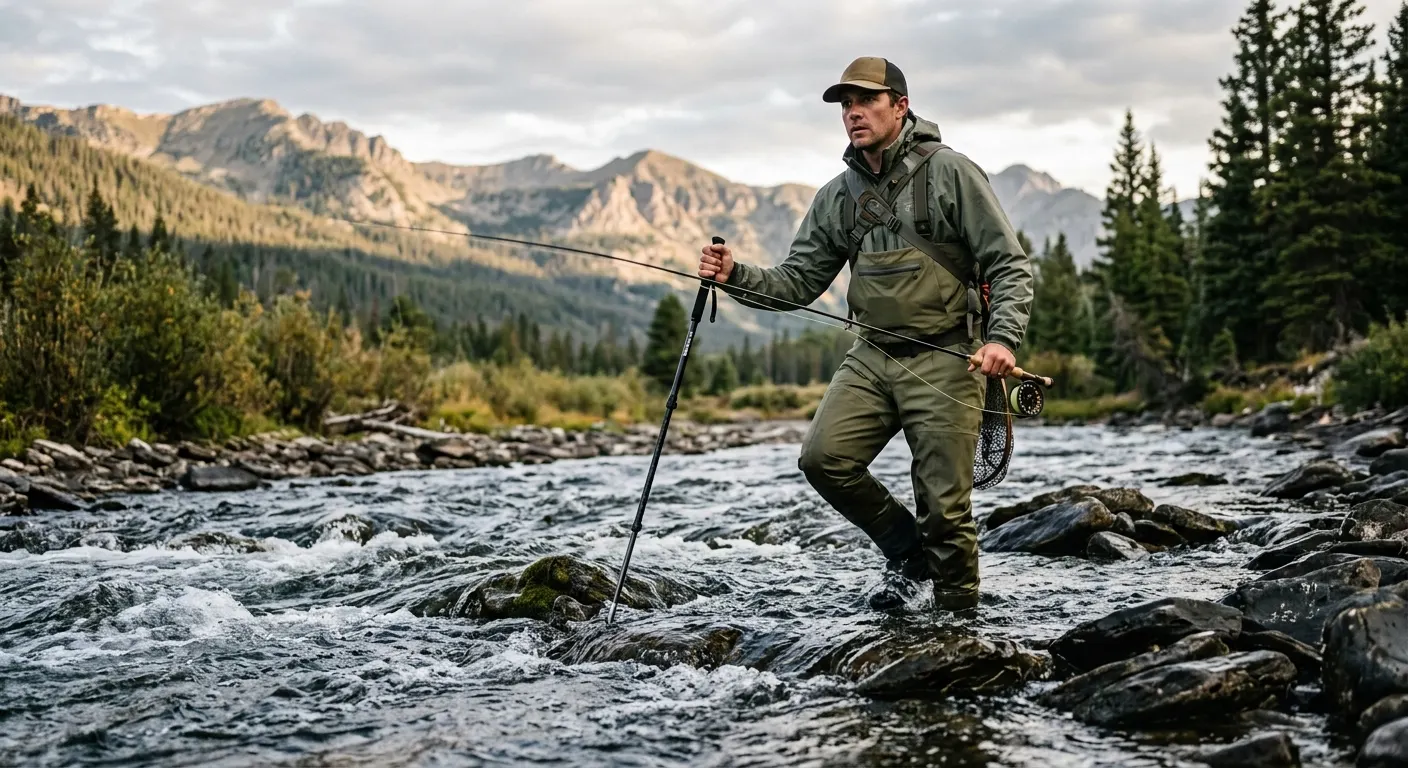
Wading Safety: Staff, Thermometer, and Technique
By RiffleDge . 10 min read . Updated June 2026
Wading is the part of fly fishing where most real injuries happen, and the falls that put anglers in the hospital were almost always preceded by the same chain of decisions: water was faster than expected, footing was more slippery than planned, and either no staff was available or the one carried was wrong for the water. This guide covers the wading tools that materially reduce fall risk, the stream thermometer that determines whether you should be on the water at all during summer afternoons, and the movement techniques that every experienced wade angler treats as second nature.
Quick answer
The Simms Wading Staff is the best collapsible wading staff for serious wade fishing, with a 14-ounce aluminum construction, tungsten carbide tip for grip on slick rocks, and a coiled tether that keeps it attached when not in use. The Orvis Stream Thermometer is the essential companion for any summer fishing in rivers subject to hoot owl temperature restrictions.
This guide contains affiliate links. RiffleDge may earn a commission at no cost to you.
Who actually needs a wading staff
The short answer is that most anglers who fish moving water benefit from a staff once they have one, but the degree of benefit varies sharply by water type. On a low-gradient tailwater with a sandy or gravel bottom in clear water where depth is easy to read, a staff is a comfort tool. On a steep freestone river with algae-covered cobble, fast pocket water, and unpredictable depth changes, a staff is a safety tool that prevents falls rather than just provides reassurance.
Anglers with knee or hip issues find that a staff relieves the constant strain of balancing against current on one leg while the other leg moves. Anglers over 50, or anyone recovering from a lower-body injury, should carry a staff on all moving water regardless of difficulty rating. The comfort-versus-safety distinction collapses the moment you feel a foot begin to slip: at that point a staff already in your hand is the difference between a recovery and a swim.
Beginning waders fishing new water are also well served by a staff. You cannot predict footing from the bank, and losing your footing in unfamiliar current is far more likely than in water you know well. A staff bought early pays dividends throughout the learning phase.
Choosing between folding, collapsible, and fixed staffs
A fixed staff is the simplest design and strongest under load, but you carry it in your hand for the entire hike to the water. Most wade fishers use folding or collapsible models that clip to a wading belt when not in use and deploy in seconds when the footing changes.
Simms Wading Staff is the benchmark collapsible staff: 14 ounces of aluminum that folds into four sections at hip size, deploys with a snap to full length, and tips with a tungsten carbide spike that bites into algae-covered rock where rubber tips skid. The foam grip handle keeps the staff usable in cold water when bare aluminum would be too cold to hold. It costs $150 to $180, which is the right investment if you wade serious water regularly.
Fishpond Lost Trail Wading Staff is the alternative under $100 with comparable folding function for anglers who do not wade the most technical fast water and want a trusted branded option without the Simms premium. The folding mechanism requires two hands to deploy compared to the Simms single-snap design, which matters in the moment you actually need it.
Folstaff Original Folding Wading Staff uses an elastic cord through aluminum sections rather than a clip-and-fold design, and has a reputation for mechanical durability that outlasts clip-style staffs by several seasons. Anglers who have had clip designs fail on them in the middle of a river crossing tend to become loyal Folstaff users. The trade-off is that it is heavier than the Simms design.

Simms Wading Staff
A 14-ounce folding aluminum wading staff from Simms with a tungsten carbide tip for grip on slick rocks, a foam grip handle for cold-water use, and a snap-together deployment that extends in seconds.

Fishpond Lost Trail Wading Staff
A collapsible aluminum wading staff from Fishpond that folds down to under 20 inches for belt storage and extends to a full-length staff, priced under $100 for anglers who want the Fishpond quality without the Simms premium.

Folstaff Original Folding Wading Staff
The original collapsible wading staff design, using an elastic cord system through aluminum sections that allows rapid single-handed deployment. A classic recommended by anglers who have broken other brands.
Attaching and using a wading staff correctly
A wading staff attached at the wrong point on your body creates as many problems as it solves. Attach via a coiled lanyard to your wading belt at hip level, not to a vest pocket or chest strap. A low attachment point means the staff hangs at your side when released rather than swinging into your back cast or dangling in front of your wading leg. The coil stretches when you plant the staff and retracts when you lift it, keeping it off the bottom rather than dragging and catching on rocks.
Always plant the staff on your upstream side so the current presses against the staff rather than angling it away from you. Moving at a slight downstream angle with the current is safer and more stable than crossing perpendicular to or against the flow. When crossing a fast seam, take it one foot at a time: plant the staff, move one foot to a stable position, confirm the footing, move the second foot. Never shuffle both feet at once in fast water.
The Orvis Stream Thermometer clips to a lanyard or zinger alongside your staff tether and gives you the water temperature reading that determines whether the river is safe for catch-and-release in the first place. High water temperature is a safety issue for the fish; unstable footing is a safety issue for the angler. Both deserve attention before you step into the river.

Orvis Stream Thermometer
A compact pocket-sized stream thermometer that clips to a vest or pack and provides an instant water temperature reading for catch-and-release decision-making during hoot owl conditions.
Stream thermometers and hoot owl restrictions
Hoot owl restrictions close rivers to fishing after 2 PM during periods when water temperature exceeds 68 degrees Fahrenheit. The restrictions exist because trout caught and handled at high water temperatures experience significantly elevated stress, which translates to post-release mortality even when the fish swims away appearing healthy. The restrictions are not universal and vary by state and specific river, but they are common enough across the American West and Mountain West that every summer trout angler should understand them and carry a thermometer.
The Orvis Stream Thermometer is a compact analog dial that clips to any zinger or lanyard, reads instantly without batteries, and costs $10 to $15. That is a small price for the information that determines whether you stay fishing or pack out for the afternoon. Check water temperature before starting a session and again around noon if you plan to fish through early afternoon. A river that reads 64 degrees at 9 AM can reach 68 degrees by 1 PM on a hot summer day with no cloud cover.
Pairing a thermometer with a good stream knowledge of which rivers run coldest on hot days, typically tailwaters releasing cold reservoir water and spring-fed streams, lets you plan around restrictions rather than being surprised by them mid-afternoon on a long drive.
Orvis Stream Thermometer
A compact pocket-sized stream thermometer that clips to a vest or pack and provides an instant water temperature reading for catch-and-release decision-making during hoot owl conditions.
Essential small wading tools: zingers, nippers, hemostats
Wading efficiency comes from having every small tool instantly accessible rather than buried in a pocket. The Loon Outdoors Rogue Zinger attaches to a vest or pack ring and holds the Dr. Slick Cyclone Nipper on a 22-inch steel cable that retracts when released. The Dr. Slick Spring Creek Hemostat on a second zinger keeps forceps immediately available for hook removal during the few-seconds window when a catch-and-release fish should be unhooked while still in the net in the water.
The difference between fumbling for tools in pockets and having them on retractors is measurable in fish welfare: faster hook removal means less time a fish spends in the net or in hand, which means lower stress and better survival rates. That is the real argument for proper zinger and retractor setups beyond simple convenience.

Loon Outdoors Rogue Zinger
A heavy-duty zinger retractor with a 22-inch steel cable and an S-Biner attachment for attaching nippers, hemostats, or a hook sharpener to a vest or pack with instant pull-and-release access.

Dr. Slick Cyclone Nipper
A precision fly fishing nipper with a ceramic cutting edge that stays sharp far longer than stainless steel, plus a hook eye cleaning needle built into the handle for clearing varnish from small hooks.
Dr. Slick Spring Creek Hemostat
A 5-inch curved hemostat for fly fishing hook removal and barbless hook crimping, with a locking mechanism that holds the fly during hook removal without fumbling.
Featured in this guide
Simms Wading Staff
A 14-ounce folding aluminum wading staff from Simms with a tungsten carbide tip for grip on slick rocks, a foam grip handle for cold-water use, and a snap-together deployment that extends in seconds.
Fishpond Lost Trail Wading Staff
A collapsible aluminum wading staff from Fishpond that folds down to under 20 inches for belt storage and extends to a full-length staff, priced under $100 for anglers who want the Fishpond quality without the Simms premium.
Folstaff Original Folding Wading Staff
The original collapsible wading staff design, using an elastic cord system through aluminum sections that allows rapid single-handed deployment. A classic recommended by anglers who have broken other brands.
Orvis Stream Thermometer
A compact pocket-sized stream thermometer that clips to a vest or pack and provides an instant water temperature reading for catch-and-release decision-making during hoot owl conditions.
Loon Outdoors Rogue Zinger
A heavy-duty zinger retractor with a 22-inch steel cable and an S-Biner attachment for attaching nippers, hemostats, or a hook sharpener to a vest or pack with instant pull-and-release access.
Dr. Slick Spring Creek Hemostat
A 5-inch curved hemostat for fly fishing hook removal and barbless hook crimping, with a locking mechanism that holds the fly during hook removal without fumbling.
Keep reading
Related roundups
FAQ
Frequently asked questions
Do I need a wading staff for fly fishing?+
It depends on the water you fish. In fast freestone rivers with slippery cobble, a staff is a genuine safety tool that prevents falls rather than just a comfort item. Anglers with knee or hip issues benefit on almost any moving water. Beginning anglers fishing unfamiliar rivers benefit from the stability margin a staff provides while they learn to read water and footing. For slow, sandy-bottomed tailwaters, a staff is optional.
What is a hoot owl restriction and how does a thermometer help?+
Hoot owl restrictions close rivers to fishing after 2 PM during hot periods when water temperature exceeds 68 degrees Fahrenheit. At that temperature, the stress of being caught and handled increases post-release mortality for trout even when fish appear healthy when released. A stream thermometer gives you the instant reading that tells you whether the river is in restriction territory so you can stop fishing before you cause harm, not after.
What tip is better on a wading staff, carbide or rubber?+
A tungsten carbide spike provides better grip on algae-covered and slick rock surfaces because it bites into the rock rather than skidding on it. Most quality staffs come with a carbide tip and include a rubber cap to protect floors and reduce noise around fish. For wading slick freestone rivers, use the spike directly without the rubber cap. The cap is primarily useful when walking on floors or in urban settings.
How do I keep a wading staff from tangling in my cast?+
Attach via a coiled lanyard to your wading belt at hip level rather than to a chest strap or vest pocket. A low attachment point keeps the staff hanging at your side when released, well below the casting plane. The coil stretches when you plant the staff and retracts when you lift it, keeping it off the water surface. A properly attached coiled lanyard does not interfere with casting at any normal casting angle.